
What to know
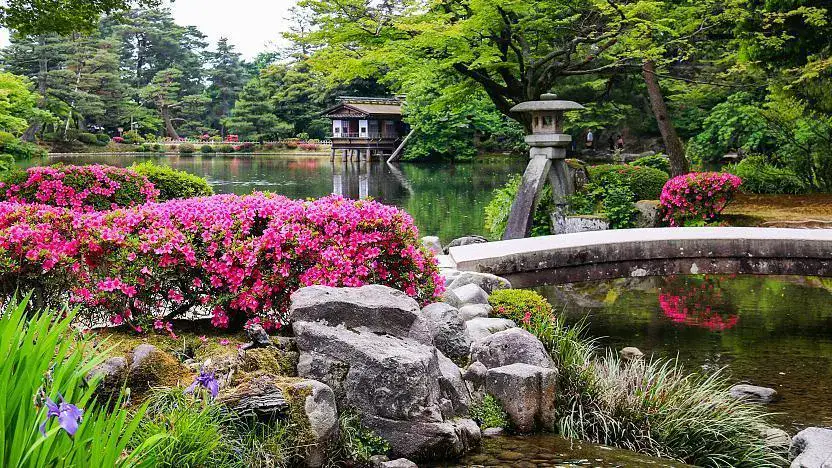
Kenrokuen (兼六園) in Kanazawa is rightfully considered one of Japan's "three most beautiful gardens," alongside Mito's Kairakuen and Okayama's Korakuen. The expansive grounds were once the outer garden of Kanazawa Castle, developed by the ruling Maeda family over nearly two centuries. Opened to the public in 1871, Kenrokuen boasts a variety of flowering trees that give the garden a distinct appearance each season.
The name Kenrokuen means "Garden of the Six Sublimities," referring to spaciousness, seclusion, artifice, antiquity, abundant water, and broad views—the six essential attributes of a perfect garden according to Chinese landscape theory. A walk through Kenrokuen brings this theory to life, with water features, bridges, teahouses, trees, flowers, stones, viewpoints, and hidden corners.
Water is channeled from a distant river via a sophisticated system built in 1632, feeding streams and ponds including the two main ones: Kasumigaike and Hisagoike. The over-two-meter-tall Kotojitoro Lantern, uniquely supported by two legs instead of one, stands on the north bank of Kasumigaike Pond and is an iconic symbol of Kenrokuen. A fountain below Kasumigaike is one of Japan's oldest, powered by the elevation drop from the pond, shooting water 3.5 meters high. Nearby, Hisagoike Pond features a small waterfall.
In spring, plum blossoms bloom at the garden's southern end from mid-February to late March, just before cherry blossom season. Cherry trees, usually flowering around mid-April, line the streams on the northeastern side. Other flowers appear during the warmer summer months, when the garden is lush with greenery.
Autumn brings fall colors, mainly from cherry and maple trees, typically changing from mid-November to early December. Orange and red maples cluster near Yamazakiyama on the eastern side near Kodatsuno Gate. In the same area stands a large bronze statue of a legendary prince, the Meiji Monument, dedicated to soldiers who died in the Seinan War, a civil war after the Meiji Restoration.
Winter offers less foliage, but fresh snow gives the garden a charming seasonal look. Many large pine trees have traditional winter protections to prevent snow damage. The Karasaki Pine, one of the garden's most prominent trees, was planted from seed and now towers beside Kasumigaike Pond, with branches extending far over the water.
Visitor information
Practical details to check before planning this stop.
- Hours
- Regular Hours:
- Closed
- No closing days
- Admission
- 320 yen (~$2.05) (free during early admission hours)
- English name
- Kenrokuen
- Original name
- Kenrokuen Garden
Verify details before visiting. Currency conversion is indicative and may vary over time.