
What to know
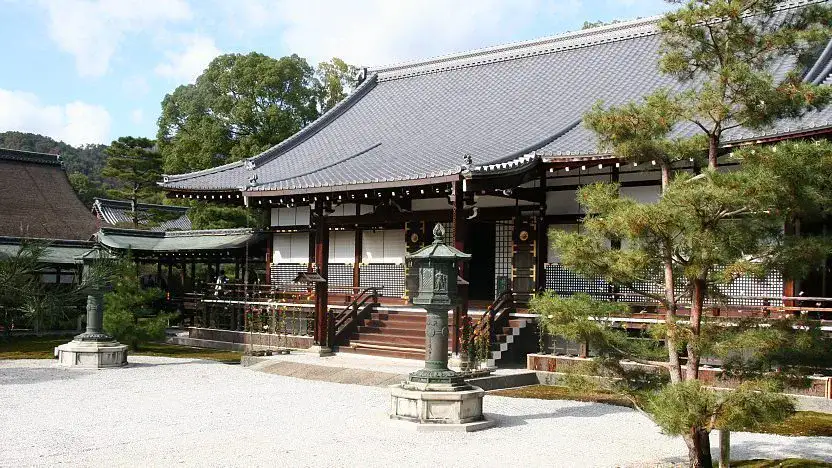
Daikakuji (大覚寺) is a sprawling temple complex in the northern part of Kyoto's Sagano district. Originally built in the early 800s as a detached palace for Emperor Saga, who loved retreating to this tranquil area on Kyoto's outskirts, it was converted into a temple thirty years after his death. Since then, it has remained one of the highest-ranking temples of Shingon Buddhism.
Daikakuji played a role in several major historical events. A succession of retired emperors ruled from here, and in the 12th century the temple hosted peace talks that reunited the Northern and Southern Imperial Courts after 50 years of civil war. The temple also appears in The Tale of Genji, Japan's first novel. Today, it is one of the best places to experience the ancient court atmosphere described in the novel and is frequently used as a filming location for historical dramas.
The temple consists of several buildings connected by elevated wooden walkways. The covered corridors, like the "nightingale floors" of Nijo Castle's Ninomaru Palace, chirp softly as you walk over them. Many buildings are decorated with painted sliding doors (fusuma) by the renowned Kano school.
One of Daikakuji's most treasured artifacts is a copy of the Heart Sutra handwritten by Emperor Saga at the instruction of Kobo Daishi. The sutra is said to have ended a mysterious plague that swept the country during the Heian Period. It is kept in the octagonal Heart Sutra Hall and displayed to the public only once every 60 years. Nearby, the Reihokan is a small museum that exhibits special collections of the temple's treasures in spring and autumn.
Adjacent to the temple is Osawa Pond, a 1,200-year-old man-made lake that is the oldest and last surviving (though incomplete) example of a Shinden-style garden. Originally built for Emperor Saga's detached palace, the pond was used for lavish parties and recreational activities like boating, fishing, and moon viewing.
The garden grounds are dotted with Buddhist statues, a small shrine, and the Shingyo Pagoda, a two-tiered tahoto-style pagoda erected to commemorate the 1,150th anniversary of Emperor Saga writing the Heart Sutra. Walking paths connect these features, allowing visitors to explore the garden, tour the buildings, and enjoy the natural scenery around the pond. The garden is especially popular during cherry blossom season (late March to early April) and autumn foliage season (late November).
Visitor information
Practical details to check before planning this stop.
- Hours
- 9:00 to 17:00 (last admission at 16:30)
- Closed
- No closing days
- Admission
- 500 yen (~$3.2) (temple), 300 yen (~$1.92) (garden around Osawa Pond)
- English name
- Daikakuji Temple
- Original name
- Daikakuji Temple
Verify details before visiting. Currency conversion is indicative and may vary over time.