
What to know
Nanzenji Temple (南禅寺) sits at the foot of Kyoto's wooded Higashiyama hills, with sprawling grounds that make it one of Japan's most significant Zen temples. As the head temple of a school within the Rinzai sect of Japanese Zen Buddhism, it encompasses numerous subtemples that expand the already vast complex.
The temple's history begins in the mid-13th century when Emperor Kameyama built his retirement villa on this site and later converted it into a Zen temple. Nanzenji grew steadily after its founding, but all its buildings were destroyed during the civil wars of the late Muromachi Period (1333-1573) and later rebuilt.
The central temple grounds are free to enter, but separate fees apply for the temple buildings and subtemples. Visitors first encounter the massive Sanmon gate, which rises above the treetops. Built in 1628 by the Tokugawa clan for soldiers who died in the 1615 siege of Osaka Castle, the gate offers a balcony climb with panoramic city views. Behind it stands the Hatto (Dharma Hall), a large lecture hall not open to the public.
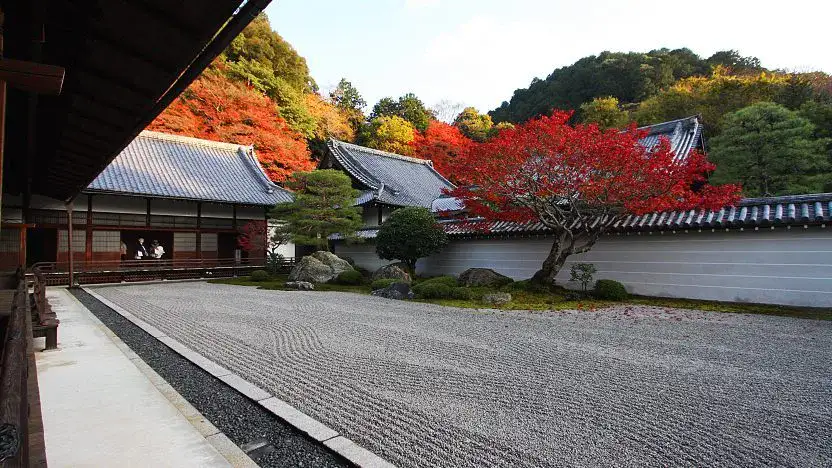
Beyond the Hatto lies the Hojo, the former head priest's residence and Nanzenji's main hall. The Hojo is famous for its rock garden, where rocks are said to resemble tigers and cubs crossing water. The sliding door paintings (fusuma) are also highly regarded, featuring realistic tigers on gold leaf. Visitors enter the Hojo complex through the former temple kitchen (kuri), which has a small tea room on the right with a view of a miniature waterfall.
Outside the Hojo, a surprising sight awaits: a large brick aqueduct crossing the temple grounds. Built during the Meiji Period (1868-1912), it is part of a canal system that carried water and goods between Kyoto and Lake Biwa in neighboring Shiga Prefecture.
Nanzenin Temple, one of Nanzenji's open subtemples, sits just behind the aqueduct on the site of Emperor Kameyama's original retirement villa. It includes the emperor's mausoleum, a temple hall, and a pond-centered garden that is especially beautiful in autumn.
Visitor information
Practical details to check before planning this stop.
- Hours
- 8:40 to 17:00 (until 16:30 from December to February)
- Closed
- December 28 to 31
- Admission
- 600 yen (~$3.84)
- English name
- Original name
- Nanzenji Temple
Verify details before visiting. Currency conversion is indicative and may vary over time.