
What to know
Oze (尾瀬) is a national park and excellent hiking destination in the mountains about 150 kilometers north of Tokyo. Its most famous features are the Ozegahara Marshland and Ozenuma Pond, along with several surrounding mountains. The park is especially popular during the late spring bloom of skunk cabbages and the early autumn fall colors, while in winter it is covered in deep snow and rarely visited.
Oze has numerous trailheads for entering the park. The trails are well maintained, with wide, elevated boardwalks crossing the Ozegahara Marshland and circling Ozenuma Pond. A hike from the Hatomachitoge trailhead past the marshland and pond to the Oshimizu trailhead takes six to eight hours for decent hikers, with no overly difficult inclines.
The park can be visited as a day trip from Tokyo, but to avoid an early start and long travel, overnight stays are possible. Several mountain huts within the park offer lodging, and accommodation is also available just outside in the Tokura area, where buses depart to the southern trailheads.
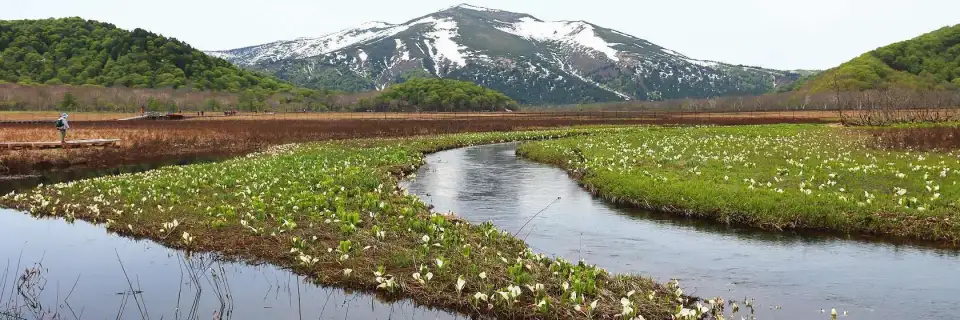
The Ozegahara Marshland, at about 1400 meters above sea level, is the park's most popular area. It is roughly six kilometers long and one kilometer wide, featuring hundreds of small, distinct pools. When walking the length of the marshland, the mountains Shibutsusan and Hiuchigatake seem to hover over hikers at either end. The Hatomachitoge trailhead is just a one-hour walk from the western end of the marshlands, making it the most popular entry point.
The most iconic image of Oze is the white skunk cabbages blooming across the marshlands in late May and early June. The marshland also becomes very attractive in late July and early August when yellow alpine lilies bloom, and during the autumn colors in late September and early October when the grasses turn bright yellow and red.
The park's second most famous feature is Ozenuma Pond, reachable from the eastern end of the Ozegahara Marshland in about an hour and a half along a forest trail. A six-kilometer path circles the entire pond, sometimes running alongside the water and sometimes through the forest. Oze's famous flowers can also be found in small marshlands near the pond.
Until 2007, most of Oze National Park was part of nearby Nikko National Park. When Oze received its own designation, a few nearby mountains were added. Although the vast majority of the park lies within Gunma and Fukushima prefectures, small sections extend into Niigata and Tochigi, so Oze stretches across four prefectures.
There are two main approaches to Oze National Park: one from the south through Gunma Prefecture and one from the north through Fukushima Prefecture. For visitors coming from Tokyo, the approach through Gunma Prefecture is much more convenient.