
What to know
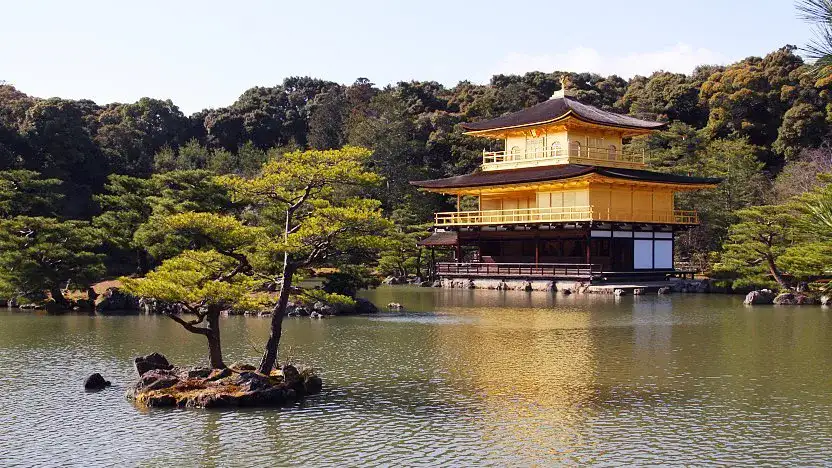
Kinkakuji (Golden Pavilion) is a Zen temple in northern Kyoto whose top two floors are completely covered in gold leaf. Officially named Rokuonji, it began as the retirement villa of shogun Ashikaga Yoshimitsu. After his death in 1408, it became a Rinzai Zen temple as he had wished. The pavilion inspired the similarly named Ginkakuji (Silver Pavilion), built by Yoshimitsu's grandson, Ashikaga Yoshimasa, on the opposite side of the city a few decades later.
Kinkakuji is a striking structure overlooking a large pond and is the only remaining building from Yoshimitsu's retirement complex. It has burned down several times throughout history, including twice during the Onin War—a civil war that devastated much of Kyoto—and once more in 1950 when a fanatic monk set it ablaze. The current structure was rebuilt in 1955.
The pavilion was designed to reflect the extravagant Kitayama culture that flourished among Kyoto's wealthy aristocrats during Yoshimitsu's era. Each floor showcases a different architectural style.
The first floor is built in the Shinden style used for palace buildings in the Heian Period. Its natural wood pillars and white plaster walls contrast with and complement the gilded upper floors. Statues of Shaka Buddha (historical Buddha) and Yoshimitsu are housed here. Although visitors cannot enter the pavilion, the statues can be seen from across the pond when the sliding doors are open.
The second floor is in the Bukke style typical of samurai residences, with its exterior entirely covered in gold leaf. Inside is a seated Kannon Bodhisattva surrounded by statues of the Four Heavenly Kings, but these are not on public display. The third and top floor is built like a Chinese Zen Hall, gilded inside and out, and topped with a golden phoenix.
After viewing Kinkakuji from across the pond, visitors pass the head priest's former living quarters (hojo), known for their painted sliding doors (fusuma), though they are not open to the public. The path then goes behind Kinkakuji and leads through the temple gardens, which retain their original design from Yoshimitsu's time. The gardens feature other points of interest, including Anmintaku Pond, said to never dry up, and statues where people toss coins for good luck.
Visitor information
Practical details to check before planning this stop.
- Hours
- 9:00 to 17:00
- Closed
- No closing days
- Admission
- 500 yen (~$3.2)
- English name
- Kinkakuji
- Original name
- Kinkakuji (Golden Pavilion)
Verify details before visiting. Currency conversion is indicative and may vary over time.