
What to know
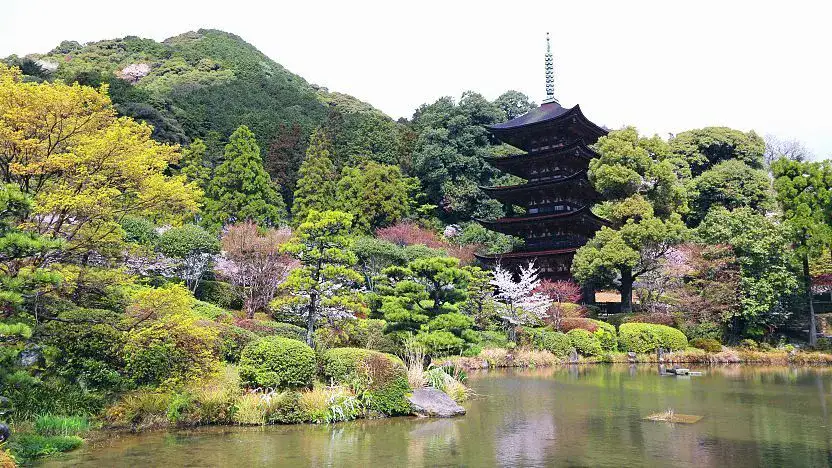
Rurikoji (瑠璃光寺) is a Buddhist temple in Yamaguchi City, famous for its five-storied pagoda, a designated national treasure. Built in 1442, this pagoda is considered one of Japan's three finest, alongside those at Horyuji Temple near Nara and Daigoji Temple in Kyoto. Interestingly, the pagoda predates the temple itself, which was established in the late 1400s.
The temple grounds are also known as Kozan Park (香山公園). Within the park, you'll find the main hall, a storehouse, a bell tower, and a small museum showcasing pictures and models of over fifty five-storied pagodas from across Japan. The museum offers interesting insights into design variations, though English explanations are limited.
Kozan Park also contains the burial site of the Mori family, who ruled the region during the Edo Period (1603–1867). Leading to the graves is the Uguisubari Stone Pavement, which produces an echoing sound when you clap or stomp—resembling the call of a Japanese bush warbler (uguisu).
Another highlight is Chinryutei, a tea house where Saigo Takamori and others secretly planned the overthrow of the Edo Shogunate, leading to the Meiji Restoration in 1868. Visitors can enter for free and explore the simple tatami rooms upstairs, while the first floor displays Japanese-language exhibits about the Meiji Revolution figures.
Rurikoji is about 2.5 kilometers north of Yamaguchi Station. You can walk (40 minutes) or rent a bicycle from outside the station (300 yen for two hours, 700 yen for a full day).
Alternatively, take a bus bound for Yamaguchi Daigaku or Nakaoguchi from the station, alight at Kenchomae bus stop (6 minutes, 170 yen, 2–3 buses per hour), then walk ten minutes to the temple.
Visitor information
Practical details to check before planning this stop.
- Hours
- Always open
- Closed
- No closing days
- Admission
- Free
- English name
- Original name
- Rurikoji Temple
Verify details before visiting. Currency conversion is indicative and may vary over time.