
What to know
Chionin (知恩院) serves as the head temple of the Jodo sect of Japanese Buddhism, a faith with millions of followers and one of the most popular Buddhist sects in Japan. The temple boasts expansive grounds and grand structures. Visitors cannot miss its colossal Sanmon Gate.
The Sanmon Gate, Chionin's main entrance, stands along the road between Maruyama Park and Shorenin Temple. At 24 meters tall and 50 meters wide, it is Japan's largest wooden temple gate, built in the early 1600s. The gate's balcony is not open to the public. Behind it, a wide staircase leads up to the main temple grounds.
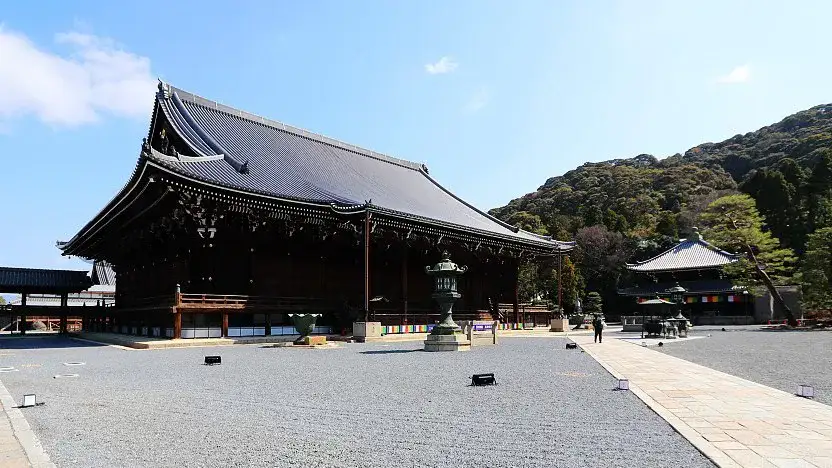
At the heart of Chionin lies an open area with stone paths connecting the main buildings. The massive Miedo Hall enshrines the temple's principal object of worship: a statue of the priest Honen, founder of the Jodo sect. Nearby, the Amidado Hall houses a statue of Amida Buddha, the most important Buddha in the Jodo sect.
Priest Honen originally followed the Tendai sect at Enryakuji Temple on Mount Hiei. In Honen's time, Buddhism was limited to monks and aristocrats, inaccessible to commoners lacking resources or education for rituals. In 1175, Honen encountered Chinese texts proclaiming salvation through faith in Amida Buddha, and soon after founded the Jodo sect.
The new sect's core belief was that Amida Buddha created a paradise accessible to all after death, requiring only recitation of Amida's name in faith. "Jodo" means "pure land," referring to Amida's paradise. This gave common people the same salvation opportunity as priests and aristocrats. The Jodo sect gained immense popularity among the masses but faced opposition from established sects.
Beyond Miedo, a path climbs the hillside to several small buildings. The Seishido Hall, dating to 1530, is the oldest structure on the grounds. There is also a mausoleum containing Honen's ashes. Elsewhere, a massive bell—the world's largest from the 17th to 19th centuries—and a few other buildings can be found.
Visitor information
Practical details to check before planning this stop.
- Hours
- Temple buildings are open from 9:00 to 16:30 (entry until 16:00)
- Closed
- No closing days
- Admission
- Free
- English name
- Chionin Temple
- Original name
- Chionin Temple
Verify details before visiting. Currency conversion is indicative and may vary over time.