
What to know
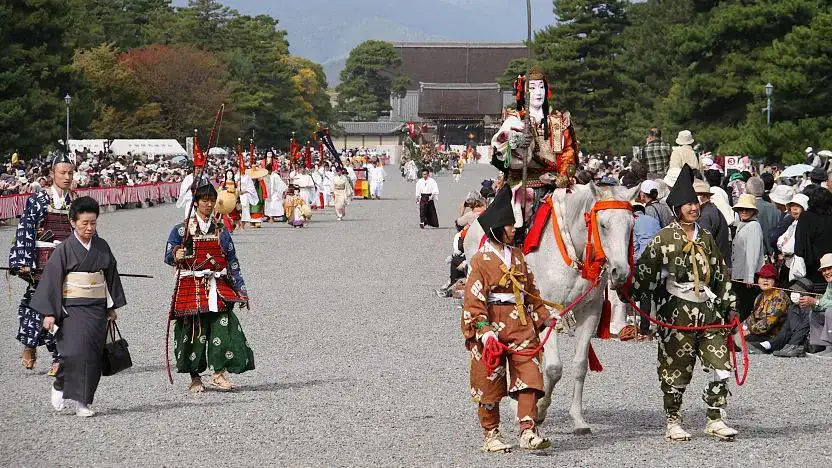
The Jidai Matsuri (Festival of Ages) takes place every year on October 22, the anniversary of Kyoto's founding. The highlight is a grand parade that winds from the Imperial Palace to Heian Shrine. Participants wear historically accurate costumes representing nearly every era of Japanese history, along with famous historical figures. Around 2,000 people take part, and watching the entire procession pass by takes about two hours.
Heian Shrine hosts the Jidai Matsuri. Both the festival and the shrine were established in 1895 to celebrate Kyoto's history and culture. Just a few years earlier, in 1868, the capital moved to Tokyo after more than a thousand years in Kyoto. Despite its relatively short history, the Jidai Matsuri ranks among Kyoto's three most famous festivals, alongside the Gion Matsuri in July and the Aoi Matsuri in May.
The parade showcases historical costumes and characters spanning the roughly 1,100 years when Kyoto served as Japan's capital. The procession is divided into historical eras and further into about twenty themes. It starts with figures from the Meiji Restoration in 1868 and then moves backward in time to the beginning of the Heian Period (794–1185).
Leading the parade are honorary commissioners riding in horse-drawn carriages styled after the mid-1800s. These include the governor of Kyoto Prefecture, the mayor of Kyoto City, and the city council chairman. Behind them come figures from the Meiji Restoration: a marching band with drums and flutes, soldiers who fought for the imperial forces, and notable personalities like Sakamoto Ryoma.
The largest group in the parade depicts the lavish convoys sent by the shogun to represent him at important imperial ceremonies in Kyoto during the Edo Period (1603–1868). The three highest-ranking officials ride on horseback, and there is a palanquin carried by attendants that the officials would use when traveling. A much smaller group follows, featuring about half a dozen famous women from the period, including a princess seated on a wheeled platform.
As the parade continues, spectators see the armor of Oda Nobunaga and his commanders, the attire of warriors and commoners from the Muromachi Period (1338–1573), more famous historical women, and nobles of the Heian Period (794–1185). The costumes and characters of military, cultural, aristocratic, and common life are all on display.
Visitor information
Practical details to check before planning this stop.
- Hours
- Closed
- Admission
- English name
- Original name
- Jidai Matsuri
Verify details before visiting. Currency conversion is indicative and may vary over time.