
What to know
During winter, Ginzan Onsen restricts access for day-trippers arriving by car to reduce congestion and prevent accidents or issues caused by unprepared visitors. In winter 2025/2026, these restrictions were in effect from December 20 to March 1.
Ginzan Onsen (銀山温泉, meaning "Silver Mountain Hot Spring") is a remote hot spring town nestled in the mountains of Yamagata Prefecture. Originally developed around a silver mine, it is now celebrated as one of Japan's most picturesque onsen towns, with historic ryokan lining the river.
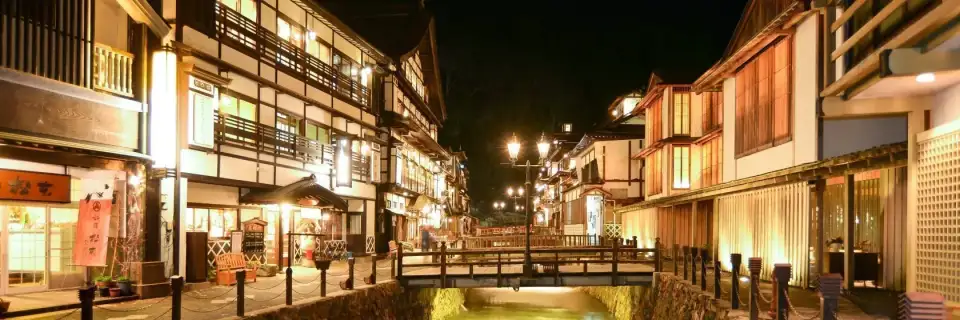
The traditionally styled ryokan of Ginzan Onsen occupy beautiful three- and four-story wooden buildings with exposed woodwork and white plaster walls, evoking nostalgia for a bygone era. One exception is the Fujiya ryokan in the town center, recently rebuilt by renowned modern architect Kuma Kengo. While purists may find it out of place, its unique modern design incorporates many traditional elements, such as exposed wood and white plaster.
The town center of Ginzan Onsen is a pedestrian-only zone due to narrow streets and limited parking. It is especially charming in the evenings when the ryokan are lit up and the streets and bridges are illuminated by gas lights. In winter, heavy snow enhances the scenery, clinging to rooftops and walkways, while in warmer months, ryokan guests often stroll around in yukata.
Two public baths (500 yen each; one is currently closed) and a free foot bath are located near the town center. The open public bath, Shiroganeyu, was also designed by Kuma Kengo. Additionally, some ryokan open their baths to non-guests during the day for typically 500–1500 yen, most featuring historic indoor baths.
A spectacular 22-meter-tall waterfall rushes constantly at the back of the town. Near its base is one of the entrances to the historic silver mine, built over 500 years ago and vital to the town during the early Edo Period. Visitors can enter the lit tunnel, but only about twenty meters are accessible.
Tourists can see more of the mines by following a nature trail up the valley for about 10–15 minutes past the waterfall. There, a slightly longer section of the former mine is open for entry. Note that the nature trail is impassable in winter and early spring due to snow.
Take the JR Yamagata Shinkansen from Tokyo to Oishida Station (about 200 minutes, around 13,000 yen one way), from where buses depart roughly every two hours for Ginzan Onsen (35 minutes, 1,000 yen one way). The train portion is fully covered by the Japan Rail Pass, JR East Pass, and JR East South Hokkaido Pass, but the bus ride is not.