
What to know
Usa Shrine (宇佐神宮, Usa Jingū), built in the 8th century, sits at the foot of the Kunisaki Peninsula. It is the head shrine of thousands of Hachiman shrines across Japan dedicated to the god of archery and war, who is also identified with the legendary 15th emperor, Emperor Ojin. The shrine greatly influenced the Kunisaki Peninsula's culture and shaped the local mountain worship religion.
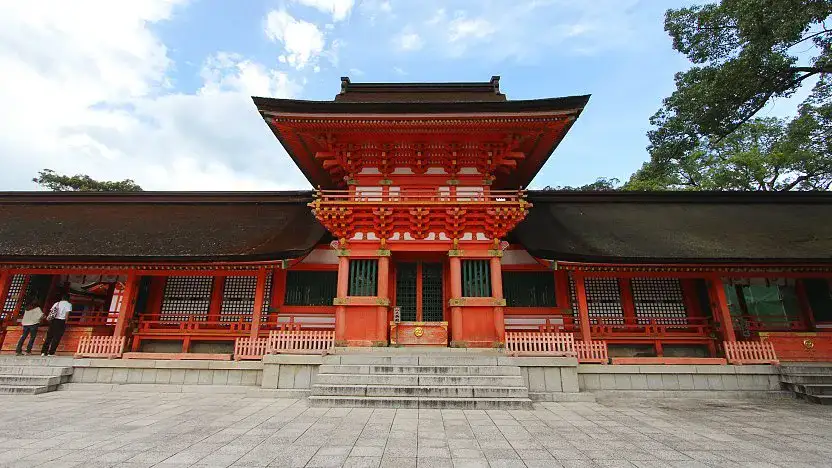
The shrine's main hall is a designated national treasure and the prototype of the Hachiman-zukuri style of shrine architecture. In this style, the shrine buildings consist of two halls whose roofs are connected, essentially forming a single building. They are surrounded by a covered corridor that makes it difficult for visitors to get an unobstructed view.
Usa Shrine occupies a large compound that includes an upper shrine complex, a lower shrine complex, a treasure hall, a couple of ponds, and several auxiliary shrine buildings. Visitors usually enter via the north or west entrance. Leading to the north entrance is a wide avenue about a hundred meters long, lined with shops selling local products and souvenirs.
The avenue leads to the Omotesando, the main shrine approach. Strolling along, visitors soon pass under a large vermilion torii gate, followed by the treasure hall on the right. The treasure hall exhibits various cultural artifacts related to Usa Shrine, including a ceremonial percussion instrument marked with peacock emblems, designated as a national treasure. However, it is almost never open.
At the west entrance, visitors first encounter Kurehashi, a beautiful unique bridge with a thatched roof. It is usually not possible to cross the bridge as its doors are opened only once every ten years during a festival. The west shrine approach meets Omotesando near a large pond with lotus plants and a noh stage at its center, connected by small bridges.
Visitors first visit the most important upper shrine complex at the top of a hill, which consists of three main halls dedicated to Hachiman (Emperor Ojin), his mother (Empress Jingu), and his wife (Hime Okami). Then they proceed to the lower shrine complex at the base of the hill, which also features three main halls dedicated to the same three deities.
Visitor information
Practical details to check before planning this stop.
- Hours
- 6:00 to 18:00
- Closed
- No closing days
- Admission
- Free
- English name
- Original name
- Usa Shrine
Verify details before visiting. Currency conversion is indicative and may vary over time.