
What to know
Kiyomizudera (清水寺, meaning "Pure Water Temple") is one of Japan's most iconic temples. Founded in 780 near the Otowa Waterfall in the wooded hills east of Kyoto, it takes its name from the waterfall's pure waters. Originally part of the Hosso sect, one of the oldest schools of Japanese Buddhism, it established its own Kita Hosso sect in 1965. In 1994, the temple was inscribed as a UNESCO World Heritage Site.
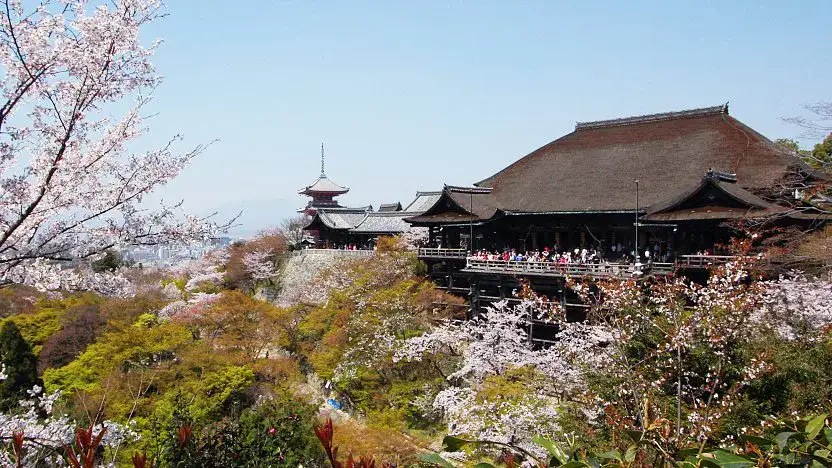
Kiyomizudera is renowned for its wooden stage projecting from the main hall, 13 meters above the hillside. The stage offers beautiful views of cherry and maple trees below, which burst into color in spring and autumn, as well as distant views of Kyoto. The main hall and stage were built without nails and house the temple's main object of worship: a small statue of the eleven-faced, thousand-armed Kannon.
Behind the main hall is Jishu Shrine, dedicated to the deity of love and matchmaking. In front of the shrine are two stones placed 18 meters apart. It is said that successfully walking from one stone to the other with your eyes closed will bring luck in love. If someone guides you, it means you will need a matchmaker in your love life.
At the base of the main hall lies the Otowa Waterfall, where water is channeled into three streams. Visitors use cups on long poles to drink from the streams, each believed to grant a different benefit: longevity, academic success, or a fortunate love life. Drinking from all three is considered greedy.
The spacious temple grounds include Okunoin Hall, a smaller version of the main hall with its own stage. Nearby are halls dedicated to Shaka Buddha (the historical Buddha) and Amida Buddha, as well as a small hall with nearly 200 stone statues of Jizo, protector of children and travelers. The three-storied Koyasu Pagoda stands among trees at the southern end, and a visit is said to ensure a safe and easy childbirth.
Around the entrance, outside the paid area, are various temple buildings including a vermilion three-storied pagoda, a sutra repository, large entrance gates, and Zuigudo Hall, dedicated to Buddha's mother. For a small fee, you can explore the pitch-black basement that symbolizes a mother's womb.
Visitor information
Practical details to check before planning this stop.
- Hours
- 6:00 to 18:00 (until 18:30 in July and August)
- Closed
- No closing days
- Admission
- 500 yen (~$3.2)
- English name
- Kiyomizudera
- Original name
- Kiyomizudera Temple
Verify details before visiting. Currency conversion is indicative and may vary over time.