
What to know
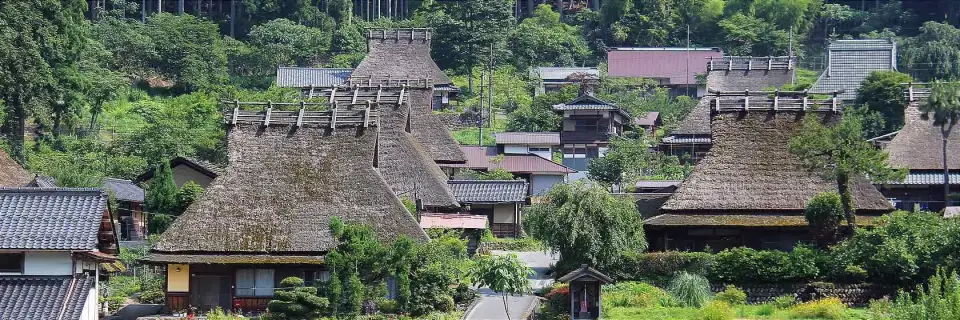
Miyama (美山) is a remote, mountainous area about 30 kilometers north of central Kyoto. It's famous for its traditional thatched-roof farmhouses (kayabuki), with over 200 scattered across the countryside. Unlike many historic towns in Japan, most of Miyama's old houses are still lived in and worked in, giving the area a nostalgic, authentic feel of rural Japan.
Miyama consists of several small villages and hamlets in narrow, winding valleys. The main attraction is the northern village, Kayabuki no Sato, which has nearly 40 thatched-roof farmhouses—the highest concentration in Japan. Visitors can stroll through the village, but most houses are private homes and not open to the public.
One public building is the Kayabuki no Sato Folk Museum, a former residence displaying traditional tools and household items, plus exhibits on thatched roof construction. Nearby is the Little Indigo Museum, a thatched building turned indigo dyeing studio and gallery. Besides these, the village has three minshuku and a cafe, plus a few souvenir shops at the tourist parking lot across the street.
The best way to appreciate Miyama's thatched roofs is to stay overnight in one. Three farmhouses in Kayabuki no Sato and several others in Miyama offer lodging. An overnight stay gives you a closer look at the houses and a chance to experience a traditional Japanese home with tatami floors, futon beds, and open hearths (irori).
The old wooden homes have a pleasant rustic atmosphere but are equipped with simple modern amenities. Baths and toilets are usually modern but shared. Overnight stays start from around 15,000 yen per person, depending on meals, which often feature local dishes like sweetfish (ayu) from the Yura River.
Miyama also offers outdoor activities like sweetfish fishing and hiking along the Yura River. A walking trail runs about two kilometers from Kayabuki no Sato to Shizen Bunkamura Kajikaso, a nature center and accommodation.
For serious hiking, visit Ashiu Forest on Miyama's eastern border, the source of the Yura River. This old-growth forest is home to deer, bears, monkeys, and the most plant varieties in Japan. Managed by Kyoto University as a research area, it requires a permit from the research station at the entrance. While you can visit independently, guided tours are easiest; reservations can be made at Shizen Bunkamura Kajikaso.
Although Miyama is only about 30 kilometers north of central Kyoto, access takes time. It's best visited as a side trip from Kyoto or en route between Kyoto and Amanohashidate or Kinosaki Onsen.