
What to know
Hara Castle (原城, Harajō) was built in 1604 on a hill overlooking the Ariake Sea. In 1637, it became the final battleground of the Shimabara Rebellion, a major uprising of peasants—many of them Christians—who were angered by heavy taxes and religious persecution under the local lord. The shogunate sent a large army to crush the revolt, but the defenders held out for over a year. Eventually, the castle was stormed, its fortifications were leveled, and the rebels were killed.
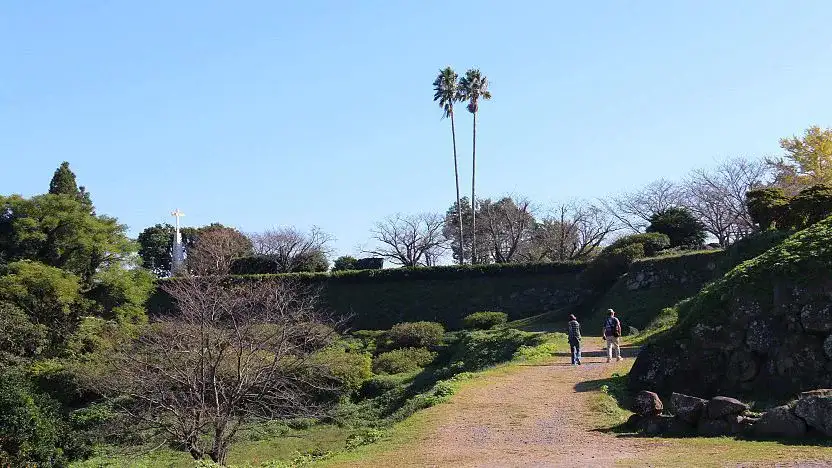
Today, only ruined fortifications remain, including the outlines of former baileys, stone walls, and the foundation stones of the castle gates. The honmaru (main bailey) is now a small park with a stone monument commemorating the rebellion. There is also a bronze statue of Amakusa Shiro, the charismatic young rebel leader, who was executed after the castle fell.
About two kilometers west of the castle stands the Arima Christian Heritage Museum (有馬キリシタン遺産記念館, Arima Kirishitan Isan Kinenkan), named after the Arima clan that once ruled the Shimabara Peninsula. The museum educates visitors on the history of Christianity in Japan, with a focus on the local Shimabara Peninsula. Half of the exhibits cover the arrival of Western traders and their impact on the economy, politics, and society.
The other half of the museum focuses on the period after Christianity was banned in Japan. This includes displays of Christian persecution, a replica of an excavation site at Hara Castle where human bones were found, and Christian artifacts excavated from the castle grounds, such as crosses, medals, and rosary beads. Unfortunately, English information is limited.
Not far from Hara Castle are the remains of Hinoe Castle (日野江城, Hinoe-jō), the main castle of the local lords and the domain's center for nearly 300 years. Hinoe Castle was also attacked during the Shimabara Rebellion, but the rebels could not take the well-fortified fortress and moved on to occupy Hara Castle instead.
Hinoe Castle was eventually abandoned in favor of Shimabara Castle further north. Today, only ruined fortifications and overgrown terraces that once formed the castle's baileys remain. Ongoing excavations have uncovered foundations and a stone staircase that was part of the main approach to the keep. The Christian lord who built the castle used stones from Buddhist gravesites to construct the staircase.
Visitor information
Practical details to check before planning this stop.
- Hours
- Always open
- Closed
- No closing days
- Admission
- Free
- English name
- Arima Christian Heritage Museum
- Original name
- Hara Castle Ruins
Verify details before visiting. Currency conversion is indicative and may vary over time.