
What to know
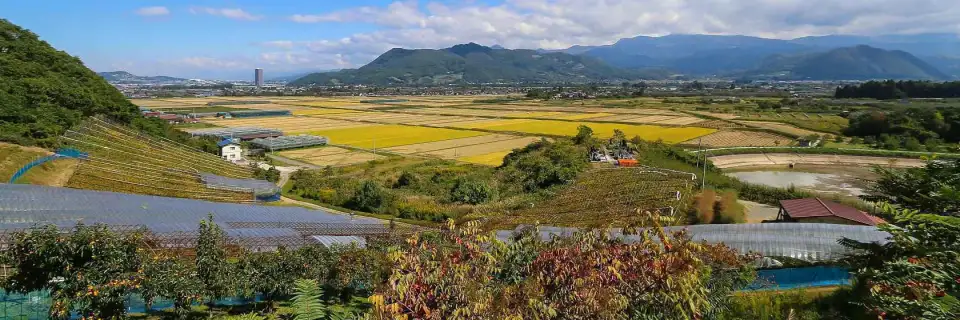
Kaminoyama Onsen (かみのやま温泉) is a hot spring town in Yamagata Prefecture at the foot of Mount Zao. According to legend, a traveling monk in the mid-1400s saw a crane soaking its wounds in the area's hot spring marshes, marking the town's origin.
Since then, visitors have flocked to Kaminoyama Onsen to bathe in its healing waters, making it one of the Tohoku Region's most famous hot springs. The town also serves as a great base for exploring Mount Zao's Okama Crater.
Most hot springs are in the town center and southwest in Hayama Onsen. Visitors can enjoy public bathhouses, foot baths (ashiyu), and many ryokan that allow daytime bathing for around 1000 yen.
Among the ryokan, Koyo Ryokan in Hayama Onsen is consistently ranked among Japan's top ryokan, offering impeccable service and outstanding local cuisine. Daytime bathing for non-guests is only available with a meal and advance reservation.
Shimo-Oyu, in central Kaminoyama Onsen, is the most historic public bath, originally built by the local lord during the Edo Period. Today it's in an aging concrete building with atmospheric gender-separated pools featuring painted scenes of Kaminoyama. It functions like a neighborhood sento where visitors can mingle with locals. Above Shimo-Oyu stands Yunoue Kannon temple ("above the hot water Kannon"), dating to the 12th century.
During the Warring States period, Kaminoyama Castle was built on a central hill. In the peaceful Edo Period, it served as the local lord's seat, but the keep was eventually demolished. The current concrete reconstruction from the 1980s sits lower on the hillside and doesn't match the original design. It houses a local history museum, has an elevator, and an observation deck with views of the town and Mount Zao.
Near the castle, a small preserved samurai district features four former homes of mid-ranking samurai along a street with feudal charm. The Miwake Samurai Residence can be entered for a small fee; the others are still inhabited or used as community space and can only be viewed from outside.
A few minutes southwest of the castle is Harusamean, the reconstructed hermitage of Zen monk Takuan, who spent three years in exile in Kaminoyama. The complex includes his living quarters, tea houses, and enclosed gardens where he taught Zen Buddhism and practiced the tea ceremony. Takuan is credited with inventing takuan, a popular pickle made from daikon radish. Also in central Kaminoyama is the Kaisendo Museum, housed in a preserved Taisho-era residence and a modern gallery. It displays the private collection of a local silk magnate, including Ming and Qing dynasty lacquerware, samurai swords and armor, traditional dolls and crafts, and historic photos of Tokyo and the countryside.