
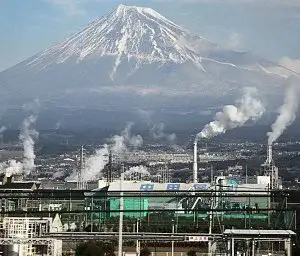
Japan did not begin large-scale industrialization until the second half of the 19th century, when Western imperialism threatened its sovereignty. To stay independent and catch up with the West, Japan successfully carried out an industrial revolution that made it the first industrialized nation in Asia within just half a century.
related places
30National Museum of Emerging ScienceAlso known as Miraikan, this well-designed, highly interactive and bilingual science museum includes a robotics section with several robots and androids on display.RobotsToyota-related museumsToyota, Japan's leading car manufacturer, has its headquarters in the city of Toyota, less than one hour east of central Nagoya. Several museums in Nagoya allow visitors to learn about the company's history and view new and old Toyota car models.AutomobilesMazda MuseumThe Mazda Motor Corporation was founded in Hiroshima in 1920 and still maintains its corporate headquarters there. The Mazda Museum offers an overview of Mazda's history, automotive technology, and future developments.AutomobilesGunkanjimaGunkanjima, formally known as Hashima Island, is an abandoned island about 20 kilometers from Nagasaki Port. It served as a coal mine until 1974, when the mines closed and everyone left, leaving the island frozen in time. Visitors can tour Gunkanjima by joining a sightseeing boat tour.MiningIwami GinzanAt its peak, Iwami Ginzan in Shimane Prefecture was one of the world's top silver mines, producing 38 tons of silver annually—about a third of global production at the time. The silver was exceptionally high quality, and the Tokugawa Shogunate took control of the mine in the early 1600s. A section of the mine and several historic buildings are open to the public.MiningSado Kinzan Gold MineDesignated a UNESCO World Heritage Site in 2024, Sado Kinzan on Sado Island was once Japan's most productive gold mine, yielding nearly 400 kg of gold per year plus smaller amounts of silver and copper. Mining ended in 1989. Today, visitors can walk through two courses inside the mining tunnels.MiningIwaki Coal and Fossil MuseumCoal mining was Iwaki's main industry until the 1960s, and the Iwaki Coal and Fossil Museum commemorates that history. The museum simulates the experience of going deep underground into a coal mine, and visitors can learn about miners' working conditions and coal collection methods over the years. It also houses an extensive fossil collection from around the world, including one excavated in Iwaki in 1968.MiningKamaishi Iron History MuseumThe Iron and Steel Museum commemorates the history of the iron industry in Kamaishi City. The city became a major iron and steel producer after magnetite was discovered there in the 18th century, and Japan's first blast furnace was built in the 19th century.Heavy industriesInujima IslandInujima is a small island off Okayama in the Seto Inland Sea. It originally supplied granite blocks for castle construction during the feudal era and later hosted a copper refinery. The refinery ruins still define Inujima's landscape and now house the Inujima Seirensho Art Museum, a fascinating contemporary art site.Heavy industriesImperial Steel WorksThe state-owned Imperial Steel Works in Yawata, Kitakyushu, were built toward the end of the Meiji Period and played a major role in the development of Japan's modern steel industry. The complex still operates under private ownership and is not open to visitors, but the nearby preserved Higashida Daiichi blast furnaces can be viewed by tourists.Heavy industriesTomioka Silk MillTomioka Silk Mill, a UNESCO World Heritage Site, was established in 1872 as Japan's first modern silk factory. It played a crucial role in making Japanese silk a major international trade commodity and establishing textiles as the country's most important industry. Visitors can see the well-preserved buildings and modern silk reeling machines.TextilesShiroi Koibito ParkShiroi Koibito Park is a theme park by Ishiya, a chocolate company famous for its flagship product, the Shiroi Koibito cookie. The park has a free area with a shop, café, and restaurant, and a paid area with chocolate-related exhibits and large windows where visitors can watch the cookie production process in the factory.Food and drinkSapporo Beer MuseumSapporo Beer, one of Japan's oldest and most popular beer brands, has been brewed in Sapporo since 1877. The Sapporo Beer Museum is housed in a former brewery from the Meiji Period. Visitors can learn about the history of beer in Japan and the brewing process. Tastings are available for a small fee after the exhibitions.Food and drinkKirin Beer FactoryKirin is one of Japan's major beer producers, and the Kirin Beer Factory is part of Kirin's brewery in Yokohama, another city that played a leading role in introducing beer to Japan. The main attraction is a brewery tour that includes tasting.Food and drinkAsahi Suita BreweryLocated in Suita City, just north of central Osaka, the Asahi Suita Brewery offers free tours of its facilities with a tasting session at the end. It is Asahi's oldest brewery.Food and drinkSuntory Yamazaki DistilleryFounded in 1923 by Torii Shinjiro, the Suntory Yamazaki Distillery just outside Kyoto is one of Japan's oldest whisky distilleries. Torii chose Yamazaki for its quality natural waters, which greatly influence the whisky's flavor. Visitors can join paid guided tours and view the Suntory Yamazaki museum, but advance reservations are required.Food and drinkNikka Whisky Yoichi DistilleryThe Nikka Yoichi Distillery near Otaru in Hokkaido is another of Japan's oldest whisky distilleries. Founder Taketsuru Masataka studied whisky-making in Scotland for several years before bringing the craft back to Japan. The distillery offers free guided and self-guided tours and a good museum. Advance reservations are not required.Food and drinkCup Noodles MuseumThis fun museum traces the history of instant noodles with interactive exhibits, modern art, and hands-on experiences. For a small fee, visitors can design their own cup noodles or make instant ramen from scratch (reservations required). There is also a food court serving noodle dishes from around the world.Food and drinkHerring MansionsDuring the peak of the herring fishing industry, wealthy fishermen built large Herring Mansions to process the fish and as residences for themselves and their employees. A well-preserved herring mansion dating from the late 19th century can be found by the water about five kilometers outside central Otaru.MarineTaiji Whale MuseumLocated in a region where whales have been hunted for centuries, the Taiji Whale Museum offers information on whales and the whaling industry from both historical and modern perspectives. Whaling methods and practices are highlighted through displays, and whale meat is available for purchase in the museum gift shop.MarineMikimoto Pearl IslandMikimoto Pearl Island, in the Bay of Toba, is an excellent museum about pearls, pearl cultivation, and Mikimoto Kokichi, the first person to successfully cultivate pearls. There are hourly performances by female pearl divers (Ama), who have traditionally planted and harvested oysters, as well as a shop where visitors can view and purchase a wide variety of pearl jewelry.MarineThe Railway MuseumThe Railway Museum by JR East in Saitama, just north of Tokyo, recounts the history of railways in Japan. The large museum features a collection of train cars and locomotives, a diorama, and multiple train driving simulators.TransportationSCMAGLEV and Railway ParkOpened in 2011 by JR Central outside central Nagoya, the SCMAGLEV and Railway Park covers the history of railways in Japan with an emphasis on high-speed trains. On display are a number of actual trains, including several generations of shinkansen and a maglev train. There are also various simulators and a diorama.TransportationKyoto Railway MuseumLocated near Kyoto Station, the Kyoto Railway Museum by JR West covers railway history with actual train cars, interesting explanatory displays, a diorama, train simulators, and Japan's largest collection of steam locomotives.TransportationHakkodamaru Memorial ShipThe Hakkodamaru ferry completed its final voyage between Aomori and Hakodate in 1988 and is now permanently moored as a museum ship, commemorating the golden age of ferry travel between Hokkaido and Honshu before the opening of the Seikan Tunnel.TransportationTokyo Stock ExchangeThe Tokyo Stock Exchange is located near Nihonbashi Bridge and is open to the public on trading days. Visitors can view the trading floor from the visitors' gallery, participate in a simulated stock trading game, and learn about the history of the Japanese securities market at the TSE Historical Museum.FinanceMinamata CityMinamata is a city in southern Kumamoto Prefecture that became infamous in the 1950s and 1960s due to an industrial mercury poisoning disaster. Today, memorials and museums related to Minamata Disease, a form of mercury poisoning from contaminated seafood, are located there.Environmental issuesJapan Mobility ShowFormerly known as the Tokyo Motor Show, the Japan Mobility Show is one of the world's top car shows, held every two years in Tokyo. It showcases passenger and commercial vehicles, motorcycles, and the latest mobility technology.Trade showsCEATECThe Combined Exhibition of Advanced Technologies (CEATEC) is the largest annual IT and electronics trade show in Japan. It is held in October at the Makuhari Messe convention center just outside central Tokyo.Trade showsTokyo Game ShowThe Tokyo Game Show is an annual trade show for video game developers held at Makuhari Messe convention center just outside Tokyo. It is one of the world's biggest game shows, where companies launch new products and showcase their latest innovations and technology.Trade shows