
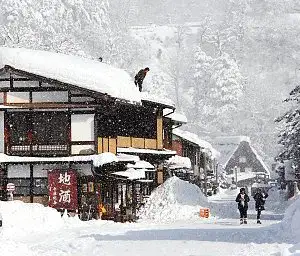
In winter, cold air masses from Siberia sweep toward Japan, gathering moisture over the Sea of Japan. When this wet, cold air hits the mountains along the coast, it causes heavy snowfall. Some areas see extreme precipitation, with snow depths reaching three to six meters.
related places
24Nyuto OnsenNyuto Onsen is a collection of traditional hot spring inns in the mountains of eastern Akita Prefecture. Many offer rustic outdoor baths with snowy winter views.Onsen in snowKusatsu OnsenKusatsu Onsen in Gunma Prefecture is famous for its abundant, high-quality hot spring water and is consistently ranked Japan's top onsen destination. The large Sainokawara Rotemburo outdoor bath offers pleasant winter landscape views.Onsen in snowManza OnsenManza Onsen is a hot spring resort town at 1800 meters above sea level on the slopes of Mount Shirane. The mountain provides the country's most sulfuric waters. Heavy winter snow makes it one of the best places near Tokyo for an outdoor bath in the snow.Onsen in snowOkukinu OnsenOkukinu Onsen is a group of four remote hot spring inns in a secluded valley in Tochigi Prefecture. They offer some of the most atmospheric, rustic outdoor baths in the Kanto Region, with milky, sulfuric waters and natural views.Onsen in snowMinakami OnsenOsenkaku, the sole inn of Takaragawa Onsen in the Minakami Hot Springs area, has some of the largest and most famous rotenburo (outdoor baths) in Japan. The mixed-gender baths are along a river and change character with the seasons. A women-only outdoor bath is also available. Takaragawa Onsen is one of the closest mixed-gender hot springs to Tokyo.Onsen in snowTokachidake OnsenTokachidake Onsen is a group of hot spring inns more than halfway up the slopes of Mount Tokachidake, an active volcano in Daisetsuzan National Park. Gender-segregated outdoor baths offer spectacular views of the Tokachidake mountains, especially breathtaking in winter.Onsen in snowSapporo Snow FestivalThe Sapporo Snow Festival is held for one week every February in Hokkaido's capital, Sapporo. It is one of Japan's most popular winter events, featuring spectacular snow and ice sculptures. Some sites also offer snow slides and snow rafting.Snow festivalsOtaru Snow Light PathThis festival is held for ten days every February in Otaru, during which the city is decorated with lights and small snow statues. The combination of snowy town and glittering lanterns creates a pleasant, romantic atmosphere.Snow festivalsAsahikawa Winter FestivalThe Asahikawa Winter Festival takes place over a week in early February, showcasing Japan's biggest snow sculpture. Other attractions include an ice sculpture competition, snow slides, and snowmobile rides.Snow festivalsYokote Kamakura FestivalThe Yokote Kamakura Festival is held annually on February 13 and 14 in Yokote, southeastern Akita Prefecture. The festival features many igloo-like snow houses called kamakura, built at various locations across the city. Children invite visitors into their kamakura and offer rice cakes and amazake, a warm sweet rice wine with zero or very low alcohol content.Snow festivalsJigokudani Monkey ParkThe snow monkeys are a troop of wild monkeys that bathe in the hot springs near Yudanaka and Shibu Onsen in Nagano Prefecture. They can be seen bathing year-round at Jigokudani Monkey Park, but are most likely seen in the hot springs during the cold winter months.Winter wondersRyuhyo (Drift Ice)The Sea of Okhotsk coast of Hokkaido is the northern hemisphere's southernmost region to see drifting ice. The ice originates from the Amur River in Russia and reaches Hokkaido typically from mid-January to early February, disappearing around mid-March to mid-April. The coast around Abashiri and the western coast of the Shiretoko Peninsula receive the most ryuhyo.Winter wondersZao Snow MonstersThe best place to see snow monsters is at Zao Onsen, a well-known hot spring and ski resort in the mountains of Yamagata Prefecture. These 'monsters' are formed by heavy snow deposited on trees and frozen into shape by chilling winds. They form around the peak of the Zao Ski Resort and are usually most spectacular around mid-February.Winter wondersCranes in the Kushiro MarshlandsKushiro Shitsugen National Park in Hokkaido was created in 1987 to preserve Japan's largest wetland and marsh habitat, which supports the only known population of endangered Japanese cranes in the country. Although the park does not receive much snowfall, it offers nature viewing, especially of the Japanese cranes that appear in numbers during winter.Winter wondersNisekoNiseko, a spectacular snow resort town in Hokkaido, is probably the most visited ski resort by foreign travelers and is very English-friendly. The almost guaranteed powder snow and fantastic views of Mt. Yotei make it a very popular destination. Although a day trip from Sapporo is possible, Niseko is best enjoyed over a few days.Ski resortsShiga KogenShiga Kogen in Yamanouchi has the largest skiable area in Japan. The resort consists of over 20 linked ski areas, accessible with one pass, offering huge variety and generally excellent snow conditions.Ski resortsHakubaHakuba is a popular ski and snowboard town in northwestern Nagano Prefecture. Happoone resort hosted downhill events in the 1998 Nagano Winter Olympics, and the scale of the resorts in Hakuba is impressive.Ski resortsYuzawaWith excellent snow, hot springs, and over twenty ski resorts, Yuzawa is a great destination for snow sports. Virtually all resorts are accessible by public transportation and offer kids' play parks. Yuzawa is just an 80-minute train ride from Tokyo, with one resort connected directly to a shinkansen station, making it the most convenient ski town for a day trip from Tokyo.Ski resortsKaruizawaOpening in early November, the Karuizawa Prince Ski Resort is one of the earliest to open, although the snow is often man-made. Karuizawa is an upscale mountain getaway for wealthy Tokyoites, with excellent shopping including an outlet mall next to the resort.Ski resortsShirakawagoShirakawago is a World Heritage Site in a remote, mountainous part of Gifu Prefecture. It is famous for its old farmhouses and typically has about a meter of snow on the ground in February, making it ideal for a rustic snow experience. On some days in January and February, the village is illuminated in the evenings.SnowscapesBieiBiei in Hokkaido is reputed to have one of the most photogenic landscapes in Japan. The small town is surrounded by gently rolling hills and vast fields, offering lovely countryside charm. It offers beautiful rural landscapes year-round, especially during the green summer, colorful autumn, and winter when everything is covered in a deep layer of snow.SnowscapesOkunikkoNikko is a good place to experience a mix of snow and culture. The shrines and temples in the town center do not see much snow, but in the higher Okunikko region around Lake Chuzenji you can usually see some snow and frozen waterfalls.SnowscapesTateyama Kurobe Alpine RouteWith unbelievable amounts of snow, the Tateyama Kurobe Alpine Route spans parts of Toyama and Nagano prefectures. The route is closed in winter, but during spring you can traverse a corridor with up to 20-meter-high walls of packed snow. The snow lasts into early summer, but the best time to traverse the corridor is in late April.Snow in springShin-Hotaka RopewayThe Shin-Hotaka Ropeway, with its unique two-storied gondolas, whisks tourists up to an altitude of 2150 meters in the Northern Japan Alps. Around the ropeway's upper station, snow can usually be encountered into June. However, activities are limited to enjoying views from the observatory and taking a few steps in the snow. Down in the valley, the Okuhida region attracts visitors with beautiful open-air hot spring baths.Snow in spring