
What to know
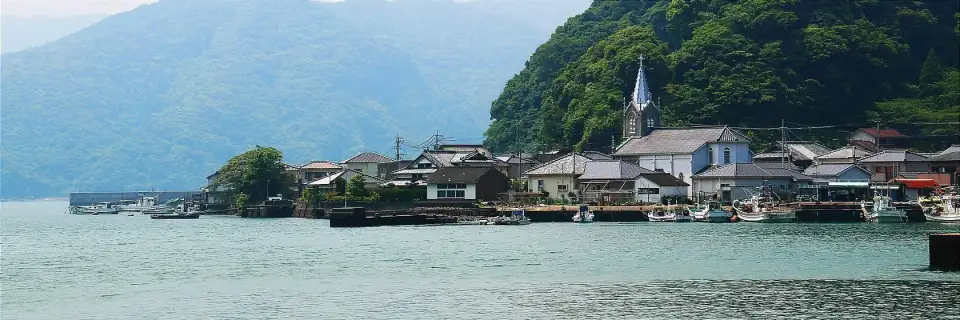
Amakusa (天草) is an island group about 60 kilometers southwest of Kumamoto City in western Kyushu. Comprising two large islands and hundreds of smaller ones, Amakusa is remote and rural, offering beautiful natural scenery. Its isolation allowed missionaries to convert a significant portion of the population, including the local daimyo, to Christianity before the religion was banned in the early Edo Period. Today, numerous museums and churches across the islands reflect this religious heritage.
The three main islands—Shimoshima, Ueshima, and Oyano—are connected to each other and to mainland Kumamoto by bridges, while ferries serve the smaller islands. Amakusa is rich in lush greenery and unique geological formations, earning it designation as a national Geopark. Wild dolphins also inhabit the waters and can be seen on boat tours.
In the early Edo Period, the Amakusa Islands suffered famine and harsh treatment of the lower classes. Fed up with heavy taxation and persecution of Christians, peasants from Amakusa and the nearby Shimabara Peninsula rose up against their lord in 1637–1638. The Shimabara Rebellion, named for the peninsula where most fighting occurred, was one of the largest peasant uprisings of the Edo Period.
The rebellion was eventually crushed by an overwhelming Shogunate force, resulting in the death of the entire rebel army, including its young leader, Amakusa Shiro. Afterward, the Tokugawa Shogunate intensified its ban on Christianity. All missionaries were expelled, and a nationwide crackdown on practicing Christians was carried out, especially in the Amakusa and Shimabara regions where the faith was widespread.
Those who continued to practice, known as "Hidden Christians," found ingenious ways to maintain their faith by disguising it as Buddhism. Images of the Virgin Mary were made to resemble the Buddhist Kannon, while crucifixes and crosses were carved into the backs of Buddhist statues or hidden in concealed objects. Christians adapted their prayers to sound like Buddhist chants and gathered secretly at night to avoid discovery.
Annual checks were conducted to root out Christians. One method required people to step on an image of Christ. Those who refused were tortured until they renounced their faith or were sentenced to death.
Below is a list of some churches and museums where religious items, statues, edicts, and stories from this period of Christianity in Japan can be seen.