
What to know
Munakata (宗像) is a city in Fukuoka Prefecture that hosts the three Munakata Shrines (Munakata Taisha), the head shrines of thousands of Munakata shrines across Japan.
The original shrine is on the remote, sacred island of Okinoshima, which is closed to the public. Located along the sea route to Korea, the island has been a place for praying for safe travel since the 4th century. The other two shrines were later established on the Kyushu mainland and on a nearby coastal island. Okinoshima Island and the Munakata Shrines were inscribed as a UNESCO World Heritage site in July 2017.
Due to its proximity to the Asian mainland, the Munakata area enjoyed great wealth and power from the 4th to the 9th centuries, when economic and cultural exchange with the mainland was at its peak. The ruling Munakata Clan controlled trade routes and presided over religious rites. Its influence waned as trade declined due to political instability on the mainland toward the end of China's Tang dynasty.
Okinoshima Island is the original and most significant worship site. This sacred island lies in the Sea of Japan, about 60 kilometers off the coast of Kyushu, roughly one-third of the way to the Korean Peninsula. On clear days, the island is visible from Kyushu. However, stepping onto Okinoshima is strictly forbidden to all except the shrine's priests. The only chance for the public to visit used to be during an annual festival in May, and even then, selected male-only visitors had to fully undress and purify themselves in the sea before landing. This annual event was discontinued in 2018. Thanks to strict rules and the island's remoteness, centuries-old ritual sites remain well-preserved.
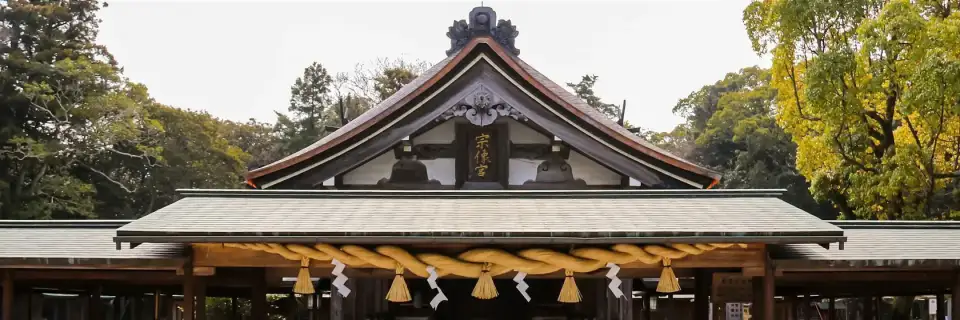
Nakatsu Shrine (Nakatsu-gu or Nakatsu-miya) is located on the island of Oshima, just off the coast of Kyushu. Rituals on the island were initially held atop Mount Mitake, and the present shrine buildings were constructed at the foot of the mountain around the 16th century. The shrine sits up some steps on a small hill near the ferry port, its secluded location offering a peaceful experience. Behind the shrine, a path leads to the summit of Mount Mitake. Hetsu Shrine, the largest of the Munakata shrines, is on the Kyushu mainland. It is the biggest, most accessible, and most popular of the three shrines. Shrine buildings were built here around the 12th century, but an ancient ritual site in the woods behind the main buildings is believed to date back to early Shinto times when worship took place outdoors without buildings.
Also within the shrine complex stands the Shinpokan Museum, a three-story treasure house containing thousands of offerings and artifacts unearthed on Okinoshima and elsewhere in the area. These include jewelry, ceramics, glasswork, equestrian tools, and more, some originating as far as Persia. The collection is impressive, but English information is limited.
Take a local or rapid train on the JR Kagoshima Main Line from Fukuoka's Hakata Station to Togo Station (30-40 minutes, 660 yen one way, frequent departures). The trip is fully covered by the Japan Rail Pass and the Kyushu Rail Pass.
Take a local or rapid train on the JR Kagoshima Main Line from Kitakyushu's Kokura Station to Togo Station (40-50 minutes, 870 yen one way, frequent departures). The trip is fully covered by the Japan Rail Pass and the Kyushu Rail Pass.