
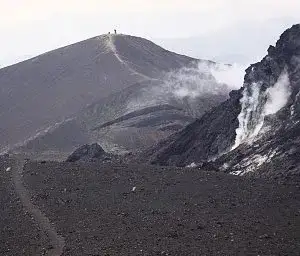
Most of Japan's mountains are volcanic in origin. While eruptions can cause destruction, many volcanoes are popular tourist attractions for their scenic landscapes, hiking trails, and relaxing hot springs. Related to volcanoes are the so-called hell valleys (jigokudani) — fields of volcanic activity that draw visitors with spectacular steam vents, hot streams, and the smell of sulfur in the air.
related places
27Mount RishiriMount Rishiri, also known as Rishiri-Fuji, is a volcano on Rishiri Island about 20 kilometers off the northern tip of Hokkaido. Over 1700 meters tall, it rises impressively out of the sea. Visitors can drive about halfway up the mountain before continuing to the peak on foot. The hike takes a full day and is quite challenging.Prominent volcanoesMount MeakanMount Meakan is an active volcano in Akan Mashu National Park in eastern Hokkaido, offering some of the best volcanic landscapes in all of Japan. It has erupted multiple times in recent decades.Prominent volcanoesMount DaisetsuzanMount Daisetsuzan is a range of peaks in Daisetsuzan National Park that includes Mount Asahidake, the tallest mountain on Hokkaido. The national park is one of the best hiking destinations in Japan from late June through September. South of Mount Daisetsuzan, but still within Daisetsuzan National Park, stands Mount Tokachidake, a 2077-meter tall peak that last erupted in 2004.Prominent volcanoesMount TarumaeLocated in Shikotsu-Toya National Park beside Lake Shikotsu, Mount Tarumae is one of Japan's most active volcanoes. It most recently erupted in 1981. Hikers can reach the summit in under an hour from a parking lot at the 8th Station and are rewarded with impressive views of the desolate landscape as well as Lake Shikotsu below. It is possible to circle the crater in about two hours, but visitors are not allowed to enter the interior due to poisonous gases.Prominent volcanoesMount UsuMount Usu last erupted in the year 2000, causing damage to the onsen town below it. Today, visitors can explore the ruined landscape via walking trails around the new west craters. On the east side of the mountain, the Usuzan Ropeway brings visitors close to the volcano's summit and older crater and offers views over Lake Toya and Showa Shinzan, a young mountain created by an eruption in 1944. Showa Shinzan is still actively venting sulfurous fumes today.Prominent volcanoesMount ZaoOn the border between Yamagata and Miyagi prefectures, Mount Zao is known for its spectacular Okama Crater, which can be reached in a short walk from a parking lot. In winter, Mount Zao is a popular site to see snow monsters (frozen trees), but access to the crater is not easily possible.Prominent volcanoesAzuma MountainsThe Azuma Mountains are a volcanic mountain range along the border of Fukushima and Yamagata Prefectures. The star attraction is Azuma-Kofuji, a miniature version of Mount Fuji that is beautifully symmetrical and can be climbed and circled in about one hour.Prominent volcanoesMount BandaiOverlooking Aizu-Wakamatsu in western Fukushima Prefecture, Mount Bandai is nicknamed Aizu-Fuji due to the mountain's former conical profile that resembled Mount Fuji. However, the mountain drastically changed shape during its last eruption in 1888, which also formed the Urabandai area. There are several hiking trails to the summit and around the base of the mountain.Prominent volcanoesMount AsamaMount Asama in Nagano and Gunma prefectures is one of the most active volcanoes on Japan's main island of Honshu. There are a number of hiking trails around Mount Asama; however, as of 1972, the crater at the summit is off limits due to volcanic activity. Mount Asama is popularly visited in combination with Karuizawa, a resort town at the base of the mountain.Prominent volcanoesMount ShiraneMount Shirane is a series of volcanic peaks above the town of Kusatsu Onsen in Gunma Prefecture, known for its easily reached, picturesque crater lake. Mount Shirane provides the high-quality, sulfuric hot spring waters to the onsen towns of Kusatsu and Manza.Prominent volcanoesMount MiharaLocated on the island of Izu Oshima, the largest of the Izu Islands, Mount Mihara is an active volcano that has seen explosive eruptions. It is possible to hike up to the summit of Mount Mihara and walk around its crater relatively easily.Prominent volcanoesMount FujiMount Fuji, the highest mountain in the country, is a beautifully symmetrical volcano and the symbol of Japan. Climbing Mount Fuji is popular during summer, with people ascending via four different trails. The Fuji Five Lakes (Fujigoko) region north of Mount Fuji is a popular resort destination with views of the mountain.Prominent volcanoesMount DaisenMount Daisen is the tallest volcano in the Chugoku Region. It is covered by a network of hiking trails of varying difficulty levels. The mountain exhibits beautiful autumn colors from late October to early November, and offers some of western Japan's best skiing in winter.Prominent volcanoesMount UnzenMount Unzen is located at the center of the Shimabara Peninsula in Nagasaki Prefecture. A well-done disaster museum at its eastern base commemorates the mountain's most recent eruptions that caused damage and deaths in the 1990s. Heisei Shinzan, now the mountain's tallest peak, was formed in the recent eruptions.Prominent volcanoesMount AsoMount Aso lies in the center of Kyushu and is part of the Aso-Kuju National Park. Its caldera is one of the largest in the world, with a diameter of about 25 kilometers and a circumference of over 100 kilometers. Nakadake Crater at the center of the active caldera is easily visited by car or ropeway, but note that it is not always accessible due to volcanic gases or activity.Prominent volcanoesKuju MountainsThe Kuju Mountains are a range of volcanic peaks in the Aso-Kuju National Park in central Kyushu. They include the Nakadake peak (1791 meters), the highest point on the island. The mountain range is covered by a network of hiking trails that offer spectacular views of the volcanic terrain.Prominent volcanoesMount KirishimaMount Kirishima is an active volcanic range on the border between Miyazaki and Kagoshima prefectures. It is a popular hiking destination with its many peaks and fascinating volcanic landscape. However, some of the trails remain closed due to the 2011 eruption of Shinmoedake. The onsen town at the base of the mountain offers quality hot spring waters.Prominent volcanoesSakurajimaLocated in Kagoshima, Sakurajima is one of Japan's most active volcanoes and the symbol of the city. Despite experiencing multiple small eruptions daily, the peninsula is inhabited and visitors can also stay on Sakurajima; however, falling ash is often an inconvenience to those living in the area. There are also a few observation points from where the eruptions can be seen from a distance.Prominent volcanoesMount KaimondakeMount Kaimondake, also known as Satsuma-Fuji, is a conical shaped mountain on the Satsuma Peninsula. It is possible to hike up the mountain in about two to three hours and take in the breathtaking views of the surrounding area. In addition to hiking, there are also hot springs and the famous sand baths in nearby Ibusuki.Prominent volcanoesMount IozanMount Iozan lies in the vicinity of Kawayu Onsen in Akan National Park and was the site of a sulfur mining operation during the Meiji Period (1868-1912). Visitors can walk around the smoking yellow sulfurous vents and eat eggs cooked in the heat of the mountain.Hell valleys (jigokudani)Noboribetsu Hell ValleyArguably Japan's most handsome hell valley, the Noboribetsu Jigokudani lies just above the town of Noboribetsu Onsen. It is home to hot steam vents, sulfurous streams, and other volcanic activity and serves as the source of Noboribetsu's hot spring waters. Walking trails through the wooded hills lead to additional areas of volcanic activity, including a footbath along a naturally warm river.Hell valleys (jigokudani)Goshogake OnsenGoshogake Onsen is a hot spring in the Hachimantai Mountains. One of Japan's best hell valleys, it lies behind the onsen's sole ryokan and features a two kilometer long, scenic walking route that leads to bubbling mud ponds, hissing sulfur vents, and hot water streams.Hell valleys (jigokudani)Tamagawa OnsenTamagawa Onsen is a unique hot spring in Towada-Hachimantai National Park. The hell valley above the ryokan features Japan's single most productive source, the country's most acidic waters, hissing sulfurous vents, and a slightly radioactive stone that is believed to have a wide range of health effects. As a result, many people spend hours lying on the radioactive rocks in the hell valley.Hell valleys (jigokudani)OwakudaniOwakudani is a hell valley in Hakone along the Hakone Ropeway. Visitors can walk along a short trail into the volcanic zone to view the steam vents and bubbling pools. Many people also purchase and eat eggs that were cooked in the naturally hot water. On clear days, good views of Mount Fuji can be enjoyed from Owakudani.Hell valleys (jigokudani)Jigokudani Monkey ParkThe Jigokudani Monkey Park in Yamanouchi is the main attraction of an otherwise minor hell valley. The park is inhabited by wild monkeys who enjoy bathing in a man-made pool, especially in winter. While there are not many signs of volcanic activity inside the monkey park, a small sulfuric vent and geyser can be seen along the path to it, and the onsen towns of Shibu and Yudanaka are located nearby.Hell valleys (jigokudani)Unzen HellsThe Unzen Hells (Unzen Jigoku) are located on the slopes of Mount Unzen. The hells surround the hot spring resort town of Unzen Onsen and provide waters to the ryokan baths around the town. There is a network of walking trails through the hells that allow visitors to see several steam vents, gushing hot springs, mud holes, and observation points around the barren, rocky area.Hell valleys (jigokudani)Beppu HellsUnlike a typical hell valley, Beppu's hells consist of eight spectacular hot spring pools that are highly developed for tourism. Six of the hells are located in the Kannawa district and two in the Shibaseki district. The eight boiling hot springs range in color from blue to red to white, and offer a variety of tourist attractions within their vicinity.Hell valleys (jigokudani)